PCOS
What happens in PCOS?
Normally every woman has small amount of androgens (male hormones such as testosterone) in her body. In PCOS there is excessive production of androgens by the ovaries & are responsible for non-ovulation.
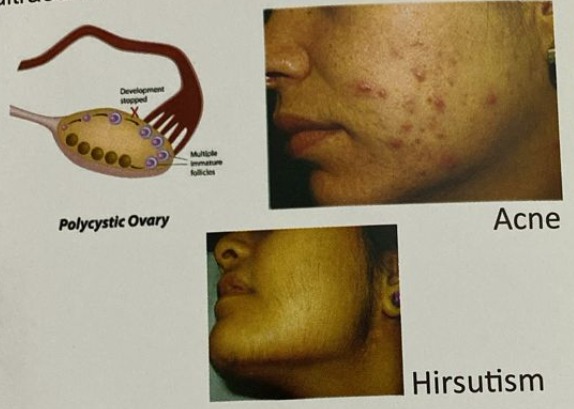
Diagnosis involves a physical examination and features of PCOS along with an ultrasound in check ovaries for polycystic appearance and a blood workup for the same.
Lack of ovulation in women in PCOS results in continuous exposure of their uterine lining (endometrium) to estrogens (female hormone). This may cause excessive thickening of the endometrium & heavy irregular bleeding.
Yes, women with PCOS may be at increased risk for developing the adverse consequences of this metabolic syndrome. These could be manifold such as abnormal lipid profile & high blood pressure with increased risk of heart disease, insulin resistance with the risk of developing diabetes early in life and also the risk of abnormal bleeding leading to cancer of the uterus.
Weight loss improves the frequency of ovulation, improves fertility, lowers risk of diabetes & lowers androgen levels in many women & therefore is an important component of therapy. Reduction in fat & sugar intake along with routine exercise like walking for 40 minutes daily will help you to achieve this.
Treatment depends upon your goals. Some patients are primarily concerned with fertility, while others are more concerned about
menstrual cycle regulation, hirsutism or acne.
If fertility is your immediate goal, ovulation may often be induced with Clomiphene citrate, an orally administered fertility medication. Treatment with medications that increases ones sensitivity to insulin such as Metformin, may lead to more regular ovulation. Gonadotrophins (injectable fertility medications) may be used to induce ovulation if you do not respond to simpler treatment. Laparoscopic ovarian drilling can be done to improve ovulatory function.
Metformin is usually administered to PCOS women with high insulin levels. However, it can also be given to women with normal insulin & normal blood sugar levels. Even though Metformin is primarily an antidiabetic drug, but it is administered now through out the world to PCOS women to effectively bring about better egg development without affecting the sugar levels & lowering intra ovarian insulin levels.
If fertility is not your immediate concern, then hormonal therapy is mandatory to correct your menstrual cycle. Hormones or specific agents (antiandrogen) can be given for the treatment of hirsutism & acne.